DROOPY LEAF1 controls leaf architecture by orchestrating early brassinosteroid signaling
作者:Meicheng Zhao, View ORCID ProfileSha Tang, Haoshan Zhang, Miaomiao He, Jihong Liu, Hui Zhi, View ORCID ProfileYi Sui, Xiaotong Liu, Guanqing Jia, Zhiying Zhao, View ORCID ProfileJijun Yan, View ORCID ProfileBaocai Zhang, Yihua Zhou, Jinfang Chu, View ORCID ProfileXingchun Wang, Baohua Zhao, View ORCID ProfileWenqiang Tang, View ORCID ProfileJiayang Li, Chuanyin Wu, View ORCID ProfileXigang Liu, and View ORCID ProfileXianmin Diao
影响因子:9.412
刊物名称:PNAS
出版年份: September 1, 2020
https://doi.org/10.1073/pnas.2002278117
Abstract
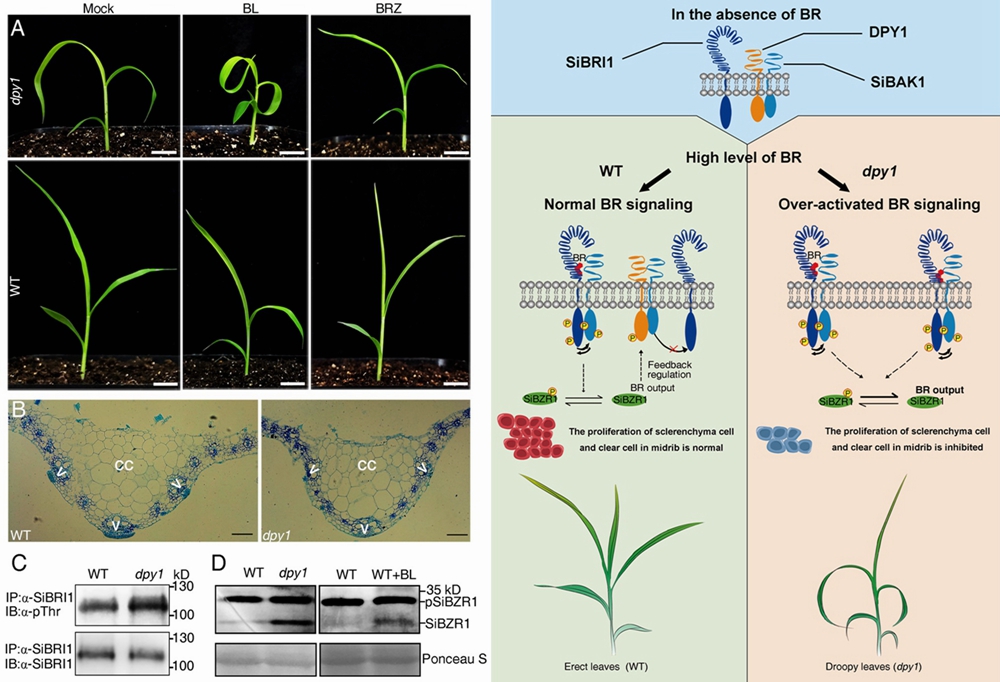
Leaf architecture directly determines canopy structure, and thus, grain yield in crops. Leaf droopiness is an agronomic trait primarily affecting the cereal leaf architecture but the genetic basis and underlying molecular mechanism of this trait remain unclear. Here, we report that DROOPY LEAF1 (DPY1), an LRR receptor-like kinase, plays a crucial role in determining leaf droopiness by controlling the brassinosteroid (BR) signaling output in Setaria, an emerging model for Panicoideae grasses. Loss-of-function mutation in DPY1 led to malformation of vascular sclerenchyma and low lignin content in leaves, and thus, an extremely droopy leaf phenotype, consistent with its preferential expression in leaf vascular tissues. DPY1 interacts with and competes for SiBAK1 and as a result, causes a sequential reduction in SiBRI1–SiBAK1 interaction, SiBRI1 phosphorylation, and downstream BR signaling. Conversely, DPY1 accumulation and affinity of the DPY1–SiBAK1 interaction are enhanced under BR treatment, thus preventing SiBRI1 from overactivation. As such, those findings reveal a negative feedback mechanism that represses leaf droopiness by preventing an overresponse of early BR signaling to excess BRs. Notably, plants overexpressing DPY1 have more upright leaves, thicker stems, and bigger panicles, suggesting potential utilization for yield improvement. The maize ortholog of DPY1 rescues the droopy leaves in dpy1, suggesting its conserved function in Panicoideae. Together, our study provides insights into how BR signaling is scrutinized by DPY1 to ensure the upward leaf architecture.